BUP
Design Operations · UX Process
Client:
Mid-size Software Company
Role:
Lead UX/UI Designer
Year:
2019
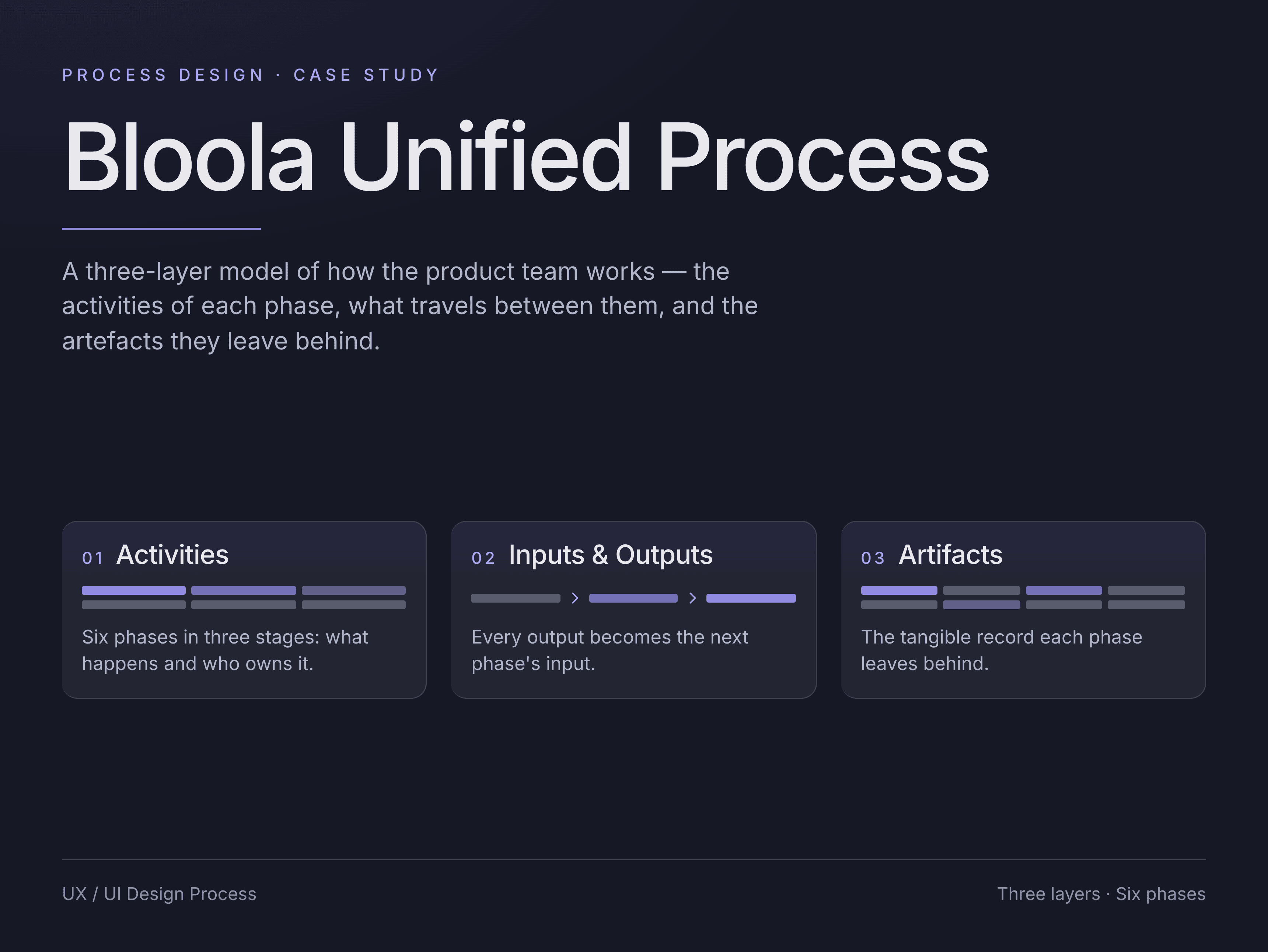
Hybrid UX process inspired by the Rational Unified Process (RUP) and Design Thinking.
Designed to improve organizational structure around product development.
Product context
bloola is a B2B software company operating across multiple industry verticals. Product development followed a traditional software engineering methodology with no UX integration.
Design decisions existed informally, but without a governance structure, defined artifacts, or cross-functional alignment.
My contribution
As the first UX designer, I identified the need and proposed BUP.
My background in software engineering gave me the methodological vocabulary to bridge UX practice with an engineering-driven organization — and the credibility to bring C-level and cross-functional teams on board.
The Problem
What does a UX designer deliver when there's no UX process to work within? They build one.
Core issue
Integrating UX into an existing development process requires more than adding a designer to the team. Without defined roles, artifacts, and phases, UX work becomes invisible — impossible to plan, measure, or scale. The organization had no UX maturity and no framework to build it.
Business issue
As the first UX hire, I needed to establish not just a workflow but a collective mindset. Without cross-functional alignment around what UX does and delivers, collaboration would remain ad hoc, and the role itself would be difficult to justify at a strategic level.
Methodology
RUP & Design Thinking
I mapped bloola's existing development process against established methodologies. RUP — Rational Unified Process — was the closest structural match to their engineering workflow. I used it as the backbone, opening each phase to integrate Design Thinking: research, ideation, prototyping, solution definition, and testing.
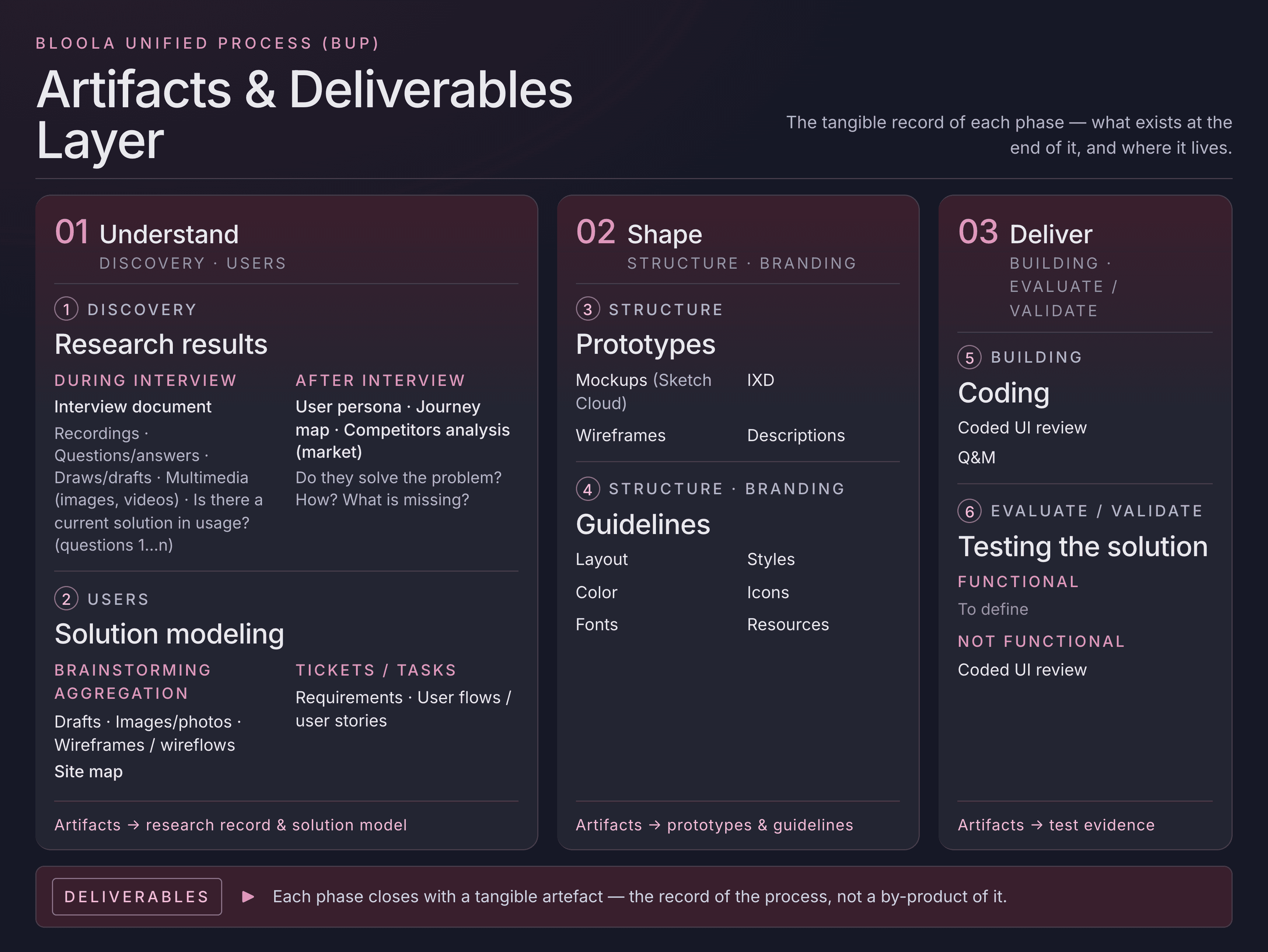
The result was a hybrid methodology that felt familiar to engineering and development teams while systematically introducing UX governance — defined input and output artifacts at every phase, clear role responsibilities, and structured feedback loops across all teams.

Key Decisions
RUP as the structural backbone
Adopting RUP wasn't arbitrary — it was a stakeholder alignment decision. Engineering teams already understood its logic. By anchoring BUP in a familiar framework, I reduced adoption friction and made UX legible in an engineering context without requiring teams to abandon their existing mental models.
Artifacts over tools
BUP defined input and output artifacts at each phase rather than prescribing specific tools. Every team member knew exactly what they needed to receive and what they were expected to deliver — creating a production chain with UX built in. This made the process tool-agnostic and scalable across different team workflows.
UX evangelization as a deliverable
Process documentation alone wasn't enough. I ran cross-functional sessions with development, QA, marketing, ideation, and management to build a shared understanding of UX — what it is, how it works, and why it matters. Establishing UX maturity organizationally was as important as the methodology itself.
Negotiating research time with the C-level
One of the critical challenges was defending adequate time for UX research phases. Stakeholder alignment at the executive level required ongoing negotiation — making the case for research as an investment, not a delay.
Structured feedback and brainstorming loops
BUP formalized collaborative touchpoints at defined phases across all teams — improving cross-functional communication by making every interaction more purposeful, with clear agendas, defined participants, and expected outputs.
Solution
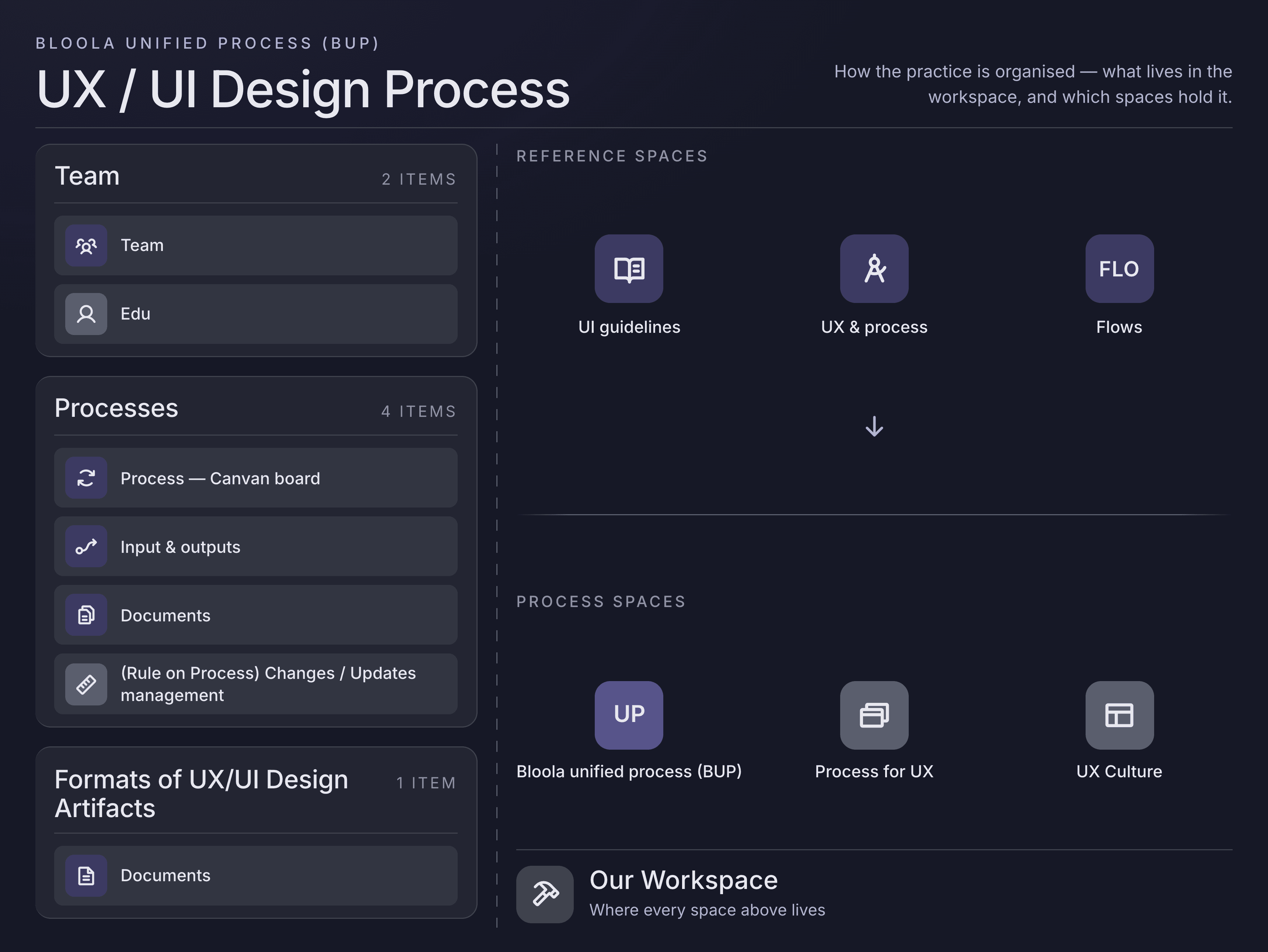
BUP (Bloola Unified Process) is a hybrid UX process designed as a layered system.
It defines phases, roles, responsibilities, and deliverables across the product lifecycle, providing structure while allowing flexibility in execution.
The process was operationalized using existing tools: Jira to structure stories and tasks across phases, and Sketch as the primary design tool within the UX/UI workflow.
The definition of BUP was developed in close collaboration with product leadership, including the CEO, CTO, and Product Management. The process took six months to define, negotiate, and deploy organizationally.


Outcome
The strategic impact was organizational: UX went from an undefined new role to a fully integrated function — with governance structure, shared language, clear responsibilities, and measurable deliverables at every phase.
BUP achieved full adoption across six cross-functional teams — design, development, QA, marketing, ideation, and management.
The primary measurable result was a ~30% reduction in development cycle time, tracked through Jira.
With BUP embedded as the standard process, it became the operating framework applied across client engagements at bloola. Each project followed the same phased structure, keeping delivery consistent regardless of client or sector.
These projects were delivered during my time at bloola GmbH (Germany). The logos shown represent client collaborations do not indicate direct employment with the listed brands. All trademarks and logos are the property of their respective owners.
